
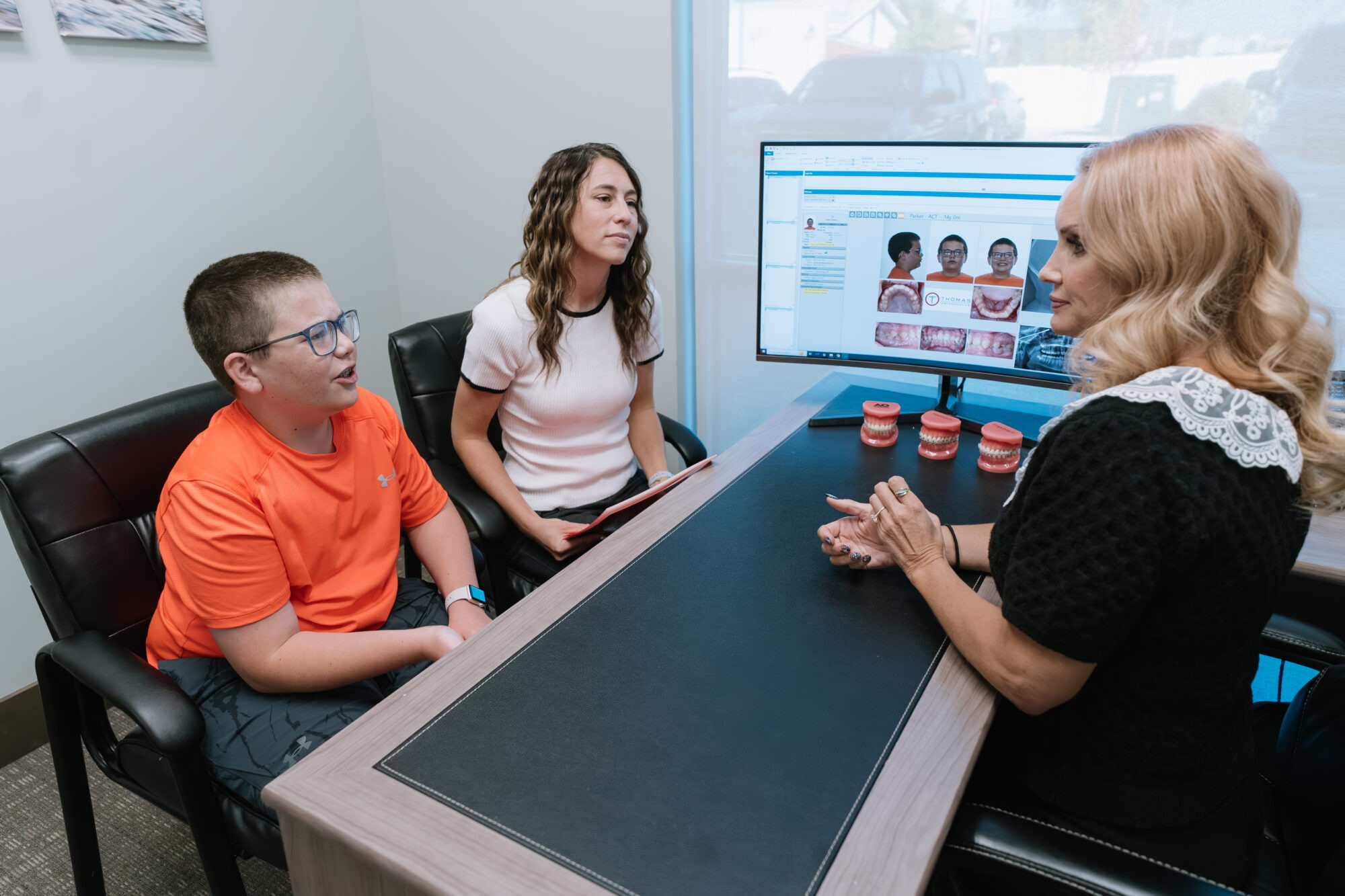
Modern orthodontics has come a long way from goopy putty trays and blurry film X-rays. Today, a small handheld wand can build a complete 3D model of your teeth in minutes. At Thomas Orthodontics, we use leading-edge 3D digital scanning to make every visit faster, more comfortable and more precise for the whole family.
Here’s a closer look at how the technology works and why it matters for your smile.
What Is 3D Digital Scanning in Orthodontics?
3D digital scanning uses a small handheld wand to capture thousands of images per second, building a precise digital model of your teeth, gums and bite. It replaces messy putty impressions with a fast, mess-free workflow. The result is an accurate digital twin of your mouth that guides every step of treatment.
At Thomas Orthodontics, board-certified Dr. Thomas uses digital scans as the foundation for planning clear aligners, metal braces, clear braces, expanders and retainers. Common technologies in modern orthodontic offices include intraoral scanners (like iTero and TRIOS) and CBCT imaging, which captures a full three-dimensional view of teeth, roots, jaw and airway.
Because the model is fully digital, Dr. Thomas can rotate it, measure it and share it with you in real time. That means you see what he sees, right there on the screen. No guesswork, and no waiting for physical molds to arrive from a lab.
How 3D Digital Scanning Works Step-by-Step
The scanning process is quick, comfortable and easy to follow. Most full-mouth scans wrap up in just a few minutes. Here’s what happens from start to finish:
Gentle capture. Dr. Thomas or a team member glides the intraoral wand around your teeth, gums and bite. There’s no pressure, no trays and nothing to bite down on.
Real-time model building. Software stitches thousands of images per second into a live 3D model that appears on-screen as the scan progresses. You can watch your smile take shape in real time.
Same-visit review. Dr. Thomas reviews the finished model with you during the same visit. He’ll point out spacing, bite alignment and areas of focus so you understand your starting point.
Treatment planning. The digital file feeds directly into planning software, where Dr. Thomas maps out tooth movements from start to finished smile.
Custom fabrication. Files are sent instantly to aligner labs or bracket systems so your appliances are made specifically for your teeth.
Progress tracking. At key milestones, quick progress scans compare current tooth positions to the treatment plan. Adjustments happen in real time, keeping your smile on schedule.
Every step is designed to reduce chair time, cut down on retakes and give you a clear window into your own care.
Key Benefits of 3D Scanning for Orthodontic Patients
Digital scanning delivers real advantages for families, from faster visits to better-fitting appliances. The technology improves both the experience of getting treatment and the quality of the final smile.
Here are the biggest benefits you’ll notice:
- Greater accuracy. Digital scans capture micrometer-level detail, which leads to better-fitting appliances and more predictable outcomes.
- Improved comfort. No goopy trays, no gag reflex and no retakes from distorted molds. The wand is small and glides smoothly around your teeth.
- Faster visits. Full-mouth scans finish in minutes with instant on-screen results. You spend less time in the chair and more time on your day.
- Better visualization. You see your current smile on the screen and can preview where treatment is headed. It’s easier to make decisions when you can actually see what’s being discussed.
- Fewer errors and remakes. Digital verification catches issues before appliances are made, reducing mid-treatment corrections.
- Enhanced oral health. A precise fit means less irritation from brackets, aligners or retainers, which supports better brushing and flossing.
- Easier record keeping. Your scans are stored digitally and can be compared across visits to show real progress.
For kids, the mess-free experience makes a real difference. For teens and adults with busy schedules, the speed matters. And for anyone who’s ever gagged through traditional impressions, digital scanning is a welcome upgrade.
3D Digital Scans vs. Traditional Impressions and X-Rays
How does digital scanning stack up against the older methods many families remember? Here’s a side-by-side look at what changes when you switch to digital.
| Feature | 3D Digital Scanning | Traditional Impressions & 2D X-Rays |
|---|---|---|
| Comfort | Small handheld wand, no trays | Bulky trays with alginate or silicone material |
| Accuracy | Micrometer-level surface detail | Prone to distortion, bubbles and shrinkage |
| Speed | Minutes, with instant results | Requires setting time, often needs retakes |
| Detail | CBCT reveals bone, roots and airway | 2D X-rays show limited anatomy |
| Sharing | Digital files transfer instantly to labs | Physical models must be shipped and stored |
| Patient experience | Watch your smile on-screen in real time | Wait days for models to be poured and reviewed |
Traditional impressions still work, but they leave a lot on the table. A distorted mold can mean an ill-fitting appliance, an extra visit or a treatment that takes longer than it should. Digital scanning solves those issues from the very first appointment.
CBCT imaging goes a step further than standard X-rays by showing three-dimensional views of bone structure, tooth roots and airway anatomy. That extra detail is especially useful for complex cases where Dr. Thomas needs to see what’s happening beneath the gumline.
Who Is a Good Candidate for 3D Digital Scanning?
Nearly every orthodontic patient benefits from digital scanning, regardless of age or case complexity. It’s part of our commitment to orthodontics for all ages at Thomas Orthodontics.
Digital scanning is especially valuable for:
- Kids ages 6 to 7 during early orthodontic evaluation, when Dr. Thomas checks jaw growth and incoming permanent teeth.
- Teens with active growth, who benefit from precise appliance design and regular progress tracking as their smile develops.
- Adults with complex dental histories, prior dental work or bone changes that require extra accuracy for predictable results.
- Complex cases involving impacted teeth, jaw discrepancies or airway concerns, which may need CBCT for full 3D anatomical detail.
- Families with strong gag reflexes or dental anxiety, who experience a much more comfortable visit without goopy trays.
- Anyone wearing clear aligners, since aligners are fabricated directly from the digital model for a better fit from tray one.
Whether your kiddo is coming in for a first evaluation or you’re an adult ready to start treatment, digital scanning meets you where you are.
Frequently Asked Questions About 3D Digital Scanning
How accurate are 3D scans compared to traditional impressions?
Digital scans are accurate to within micrometers, which is significantly more precise than traditional putty impressions. Physical molds can shrink, distort or trap air bubbles, all of which affect how well an appliance fits. Digital models don’t have those issues, so your braces, aligners or retainers fit right the first time.
Are 3D dental scans safe for kids and teens?
Yes. Intraoral digital scans use no radiation at all, so they’re safe for kids, teens and adults. When a CBCT scan is needed for a more detailed 3D view, it uses a very low dose of radiation that is carefully controlled and only used when clinically necessary. Dr. Thomas always recommends the least amount of imaging needed to plan your treatment well.
Does 3D scanning speed up orthodontic treatment?
In many cases, yes. Precise planning and better-fitting appliances mean fewer mid-treatment corrections, fewer emergency visits and smoother progress overall. Digital scans also allow Dr. Thomas to spot issues early and adjust the plan quickly, which helps keep your treatment on schedule.
How does 3D scanning improve clear aligner results?
Clear aligners are fabricated directly from your digital scan, so each tray is custom-made to match your teeth exactly. That precision means better tracking of tooth movements, fewer refinements and a smoother path from your first tray to your finished smile.
When would a CBCT scan be recommended?
CBCT is typically recommended for impacted teeth, jaw alignment concerns, airway evaluation or planning that involves other dental specialists. It shows bone structure and tooth roots in three dimensions, giving Dr. Thomas the full picture he needs for complex cases. For most routine orthodontic care, an intraoral scan is all that’s required.
Ready to See Your Smile in 3D?
Digital scanning is one of the many ways Thomas Orthodontics blends leading-edge tech with small-town heart. From your first free consult through your final retainer check, Dr. Thomas uses precise digital tools to design a smile that fits your face, your bite and your life.
Curious what your own 3D scan would reveal? Schedule your free consult today and see your smile come to life on-screen. We’re glad you’re here.