
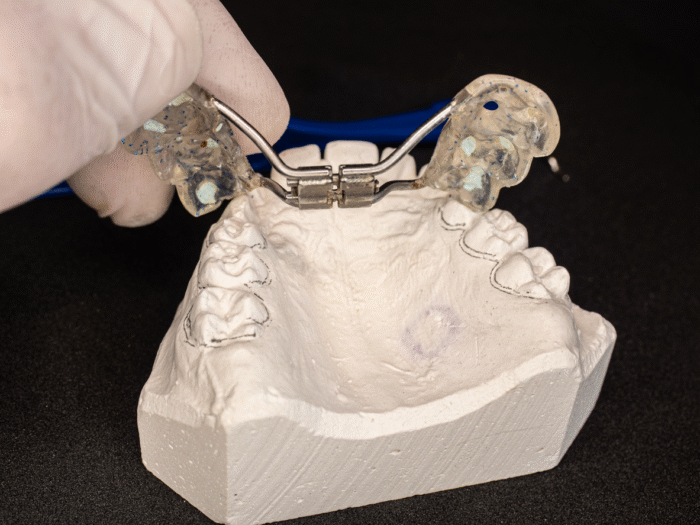
If your child has a narrow upper jaw, a crossbite or not enough room for incoming teeth, Dr. Thomas may recommend a palatal expander. Palatal expanders for kids are early treatment appliances that gently widen the upper jaw while it’s still growing. At Thomas Orthodontics, they’re often part of Phase 1 treatment, which sets up a healthy, balanced smile for later.
Here’s what parents should know before their child’s first expander visit.
What Is a Palatal Expander?
A palatal expander is a custom appliance that gradually widens the upper jaw to make more room for teeth and improve the bite. It works best in kids whose upper jaw is still growing, usually from around age 7 into the early teen years, while the two halves of the palate haven’t fully fused.
Most expanders have two sides attached to the upper back teeth, connected in the middle by a small screw. Small, regular turns of that screw apply gentle pressure that slowly widens the palate, and new bone fills in the space.
A palatal expander is often used to:
- Make room for crowded adult teeth
- Correct a crossbite, where upper teeth sit inside the lower teeth
- Guide healthy jaw growth during the growing years
- Lower the chance of canine teeth getting stuck under the gums
Expanders are a common part of Phase 1 treatment. Addressing jaw growth early means braces or clear aligners later can focus on fine-tuning the smile.
How a Palatal Expander Works
An expander puts small, steady pressure on the roof of the mouth. Over time, that gradually separates the seam down the middle of the palate, and new bone fills in to create a wider, more balanced upper arch.
Here’s how the process usually goes:
- Evaluation. Dr. Thomas takes digital scans and checks how your child’s teeth and jaw are developing.
- Placement. The expander is attached to the upper back teeth during a short visit.
- Turns at home. A parent uses a small key to turn the center screw on the schedule Dr. Thomas sets. Each turn widens the palate by a tiny amount.
- Active expansion. This stage usually lasts a few weeks, depending on how much widening is needed.
- Holding phase. The expander then stays in place for a few more months so new bone can form and hold the results.
Your part as a parent matters. Consistent turns and regular check-ins keep treatment on track. Mild pressure, tingling or tightness for a little while after a turn is normal. Sharp pain isn’t, so call our office if that happens.
Benefits of Palatal Expansion
When the upper jaw grows into the right shape during childhood, many future orthodontic problems can be avoided altogether.
How Does Expansion Make Room for Adult Teeth?
Widening the arch creates space so adult teeth can come in where they belong. That often reduces the need to remove teeth later, and for kids with a lot of crowding, it can make the next phase of treatment much simpler.
How Does an Expander Correct a Crossbite?
When the upper arch is too narrow, the bite can shift to one side. Expansion lines up the upper and lower jaws for a balanced bite, which also helps the face grow evenly.
Other benefits can include:
- Easier breathing. A wider palate can open up the nasal passages, which may reduce mouth breathing and snoring in some kids.
- Fewer stuck canines. Crowded upper arches can trap canine teeth under the gums. Expansion gives them room to come in.
- A smoother Phase 2. A well-shaped arch makes braces or clear aligners more efficient later, which can shorten the second phase of treatment.
The American Association of Orthodontists recommends a first orthodontic evaluation by age 7, which is often right when an expander can do the most good.
What Expander Treatment Looks Like at Home
The expanders we use at Thomas Orthodontics are adjusted at home with a tiny key. A few quick turns on the schedule Dr. Thomas sets are all it takes, and most families settle into the routine within the first few days.
Dr. Thomas will walk you through every step, show you how to make the turns and answer your questions at your free consult.
What Affects the Cost of a Palatal Expander
Expander costs depend on the type of appliance, how long treatment lasts and how complex the case is. These are the main factors:
- Your child’s case. How much widening is needed shapes the appliance design and the lab work behind it.
- Treatment length. A longer holding phase can mean more check-ins.
- Insurance coverage. Many dental insurance plans include orthodontic benefits for kids under 18, and our team will help you get the most out of yours.
- Long-term savings. Early expansion often reduces the need for tooth removal or more involved treatment later.
A first visit at Thomas Orthodontics is free and includes no-cost digital X-rays and digital scans. We also offer interest-free financing and accept HSA and FSA payments.
Is Your Child a Candidate for an Expander?

Most kids who benefit from an expander are between about 7 and the early teen years, while the palate is still flexible enough to respond. After that, widening the upper jaw becomes much harder.
Signs your child may need an expander include:
- A crossbite
- Crowded or overlapping front teeth
- A narrow upper arch or high palate
- Adult teeth that seem blocked or stuck
- Frequent mouth breathing or snoring
- A jaw that shifts to one side when biting
At your child’s evaluation, Dr. Thomas uses digital scans and digital X-rays to check how the teeth and jaw are developing. He’ll let you know whether expansion makes sense now, whether to keep an eye on growth or whether no treatment is needed at all.
Once the palate fuses in the teen years, an expander can’t widen it the same way, which is one more reason an early evaluation matters.
Frequently Asked Questions
How long do kids wear a palatal expander?
The active widening stage usually takes a few weeks, and the expander then stays in for a few more months while new bone forms. Dr. Thomas will give you your child’s exact timeline.
Does a palatal expander hurt?
It shouldn’t. Your child may feel some pressure or tightness for a little while after a turn, but sharp pain isn’t expected. Most kids get used to it within the first week. If your child feels more than mild pressure, give our team a call.
Will my child talk differently with an expander?
A slight lisp is common for the first few days while the tongue gets used to the appliance. Speech usually goes back to normal quickly, and reading out loud can help.
Will an expander change my child’s face?
Expanders widen the upper arch, which can make the smile look a little fuller. Big changes to the face aren’t typical.
Can the palate be widened without an expander?
Not reliably. Habits and exercises won’t widen the upper jaw. An expander works while the palate is still growing, which is why an early evaluation matters.
What foods should kids avoid with an expander?
Skip sticky candy, hard nuts, ice, gum, popcorn and anything crunchy enough to bend or loosen the appliance. Soft foods are easiest for the first few days, and our team will go over the foods to avoid at the placement visit.
Wondering if a palatal expander is the right next step for your child? A free consult with Dr. Thomas is the easiest way to find out.